

Deep links to specific content
Want to send guests directly to a specific section of the guidebook—like House Rules, Check-in Instructions, or Local Recommendations? That’s where Deep Links come in. They will work in conjunction with any type of access (general share links, reservation links, or public links).
When to use deep links
Deep links are useful any time the guest needs one specific piece of information:
Pre-arrival directions. Send a link that opens straight to the Directions article so guests can find the property without scrolling past anything else.
Check-out instructions. Drop a link to the Checkout article in your departure-day message.
WiFi or door code on a sign. Print a QR code that opens directly to the WiFi article, no menu to navigate.
Restaurant recommendations. Share just the “Where to eat” subcategory when a guest asks.
Inside automated PMS messages. Paste a deep link into a pre-arrival or in-stay automated message so every guest sees exactly the article you want them to see, with no per-booking work.
What you can deep-link to
Any of the three levels of your guidebook content:
A category (e.g., “Things to know before you travel”)
A subcategory (e.g., “Before you leave home”)
A specific article (e.g., “What we provide”)
How to create a deep link
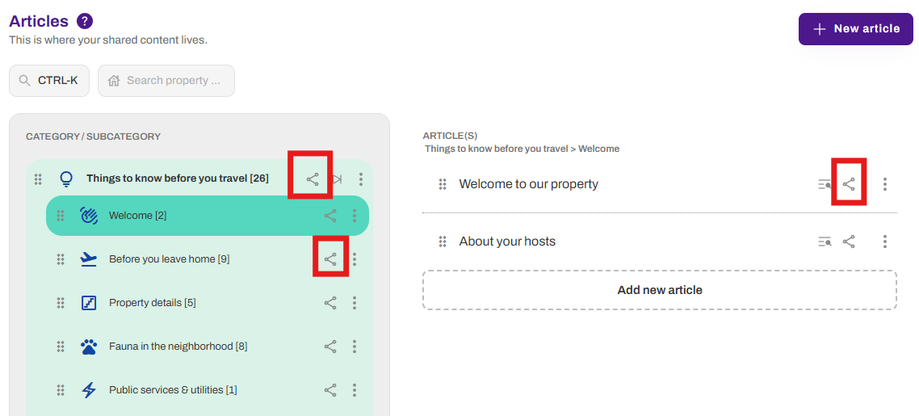
In your dashboard, go to Content Hub → Articles.
Find the category, subcategory, or article you want to link to.
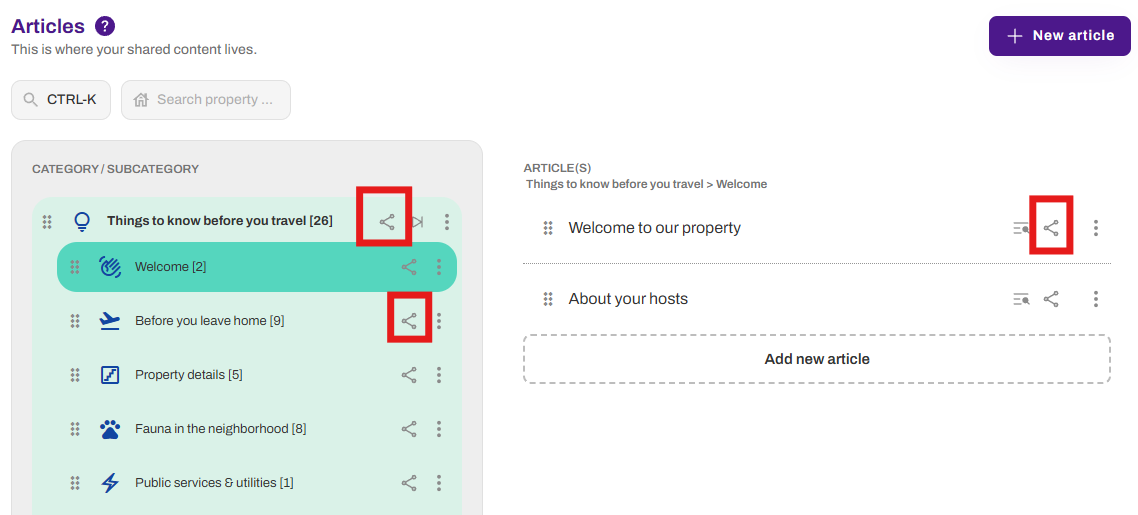
Click the share icon on the right side of that row.
Choose the type of access (general share link, public link or reservation link).
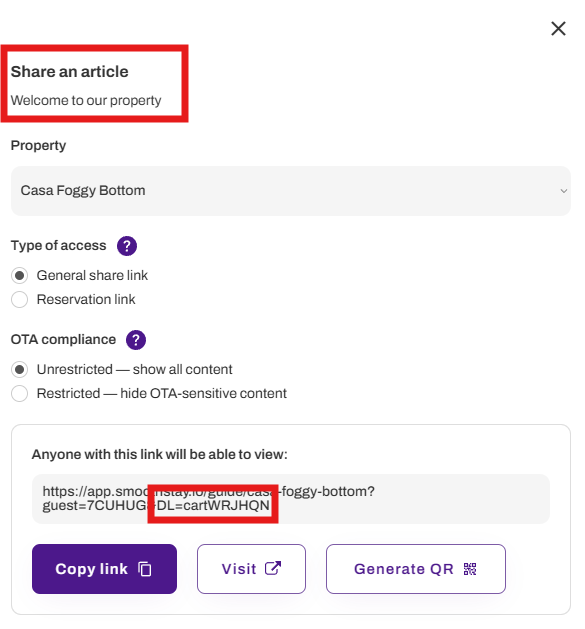
If you chose a reservation link, pick the upcoming reservation from the dropdown.
Copy the URL.
That URL opens directly to the content you selected.
⚠️ Important: If you change the custom URL path or the token for the general share link, all previously shared deep links will break. Be sure to finalize your URL settings before sharing deep links.
What deep links do (and don’t do)
Under the hood, a deep link is just your existing share link with a DL parameter appended (for example, &DL=cartWRJHQN at the end as seen in the image above).
The parameter tells the guidebook which article to open. The same approach applies to every link type, whether general share, reservation, or public, so deep links inherit everything from the underlying link: expiry rules, OTA compliance, and the URL slug.
If you change the base link, every deep link built on it changes too.